For eight minutes, the satellite is yours.
Then it's gone, below the horizon, out of reach, silent, until the following contact at the next station.
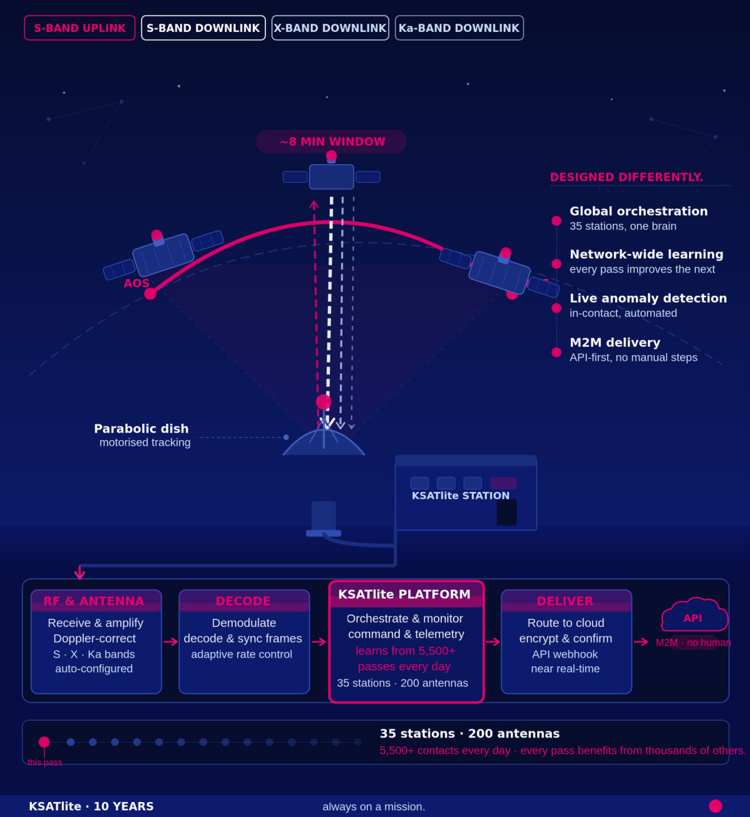
In those minutes, everything must work: the antenna must find the spacecraft and track it precisely as it crosses the sky. The radio link must lock, decode, and hold. Telemetry must flow. Commands must land. Payload data must transfer, encrypt, and route to its destination before the window closes.
This is a contact. And with KSATlite, it happens more than 5,500 times a day.
Customer perspective: Read our conversation with with Etienne Vincent, Director of Engineering at Loft Orbital about the role of the ground segment.
More than an RF link
From the outside, a contact looks simple. A satellite rises, an antenna follows it across the sky, data arrives. Clean, unremarkable, routine.
That simplicity is the product of a system working very hard not to be noticed.
Behind every pass is an orchestration layer that coordinates antennas, radios, network routing, mission schedules, and monitoring infrastructure in real time, across a global KSATlite network of nearly 35 stations and 200 antennas. By the time the satellite rises above the horizon, every component is already configured and waiting.
Read the first chapter in our KSATlite series.
The contact that knows about every other contact
Here is what makes a KSATlite contact different from a standalone ground station event: it doesn't happen in isolation.
Every contact contributes to a shared operational dataset. Every anomaly detected, every link behavior logged, every performance metric recorded, across all stations, all missions, all contacts, feeds back into how the next contact is executed.
A satellite that experienced irregular link behavior over Svalbard at 09:14 makes the 09:22 contact over another station slightly better. Not through manual intervention. Through a system that has been tested and evolved over the last 10 years. This is the compounding effect of operating at network scale: individual contacts get smarter because the whole network is learning.
Read the second chapter in our series about KSATlite
What happens in those eight minutes
The orchestration layer manages more than the antenna pointing. During each contact, the system handles simultaneously spacecraft commanding, real-time telemetry acquisition and streaming, payload data transfer, network routing to downstream systems, and continuous monitoring for anomalies, on the ground, on the link, and on the spacecraft itself.
Operators can reach into a live contact through monitoring and control APIs, observe what's happening in real time, and reconfigure if needed. For most contacts, they never need to. The system handles it.
Data that doesn't stop moving
The value of a contact isn't in the antenna. It's in what happens to the data after it lands.
During a KSATlite contact, payload data is injected directly into KSAT's terrestrial network and routed in near real time, to cloud environments, processing pipelines, analytics platforms, and the operator's own systems. The contact ends; the data keeps moving.
As constellations grow and satellite operations become increasingly automated, this seamless handoff between the ground segment and the downstream value chain becomes the difference between data that is collected and data that is acted on.
5,500 times a day. Every day.
One contact is often just eight minutes of coordinated complexity, made to feel effortless.
Five thousand contacts is a global infrastructure, learning from itself, running without pause.
At KSATlite, we've spent ten years building the difference between those two things. The contact is where you see it.