There is a moment in the life of every growing satellite company when the ground segment stops being an engineering problem and becomes a business decision.
For GHGSat, that moment came as the Montreal-based company began scaling its fleet of greenhouse gas detecting satellites into a robust commercial service capable of viewing the entire world every day and monitoring millions of industrial facilities every year. The question was direct: build a ground infrastructure and operating team of your own, or trust someone else with the mission-critical interface between your satellites and your data?
"We always knew that our sweet spot would be tens of satellites, not hundreds or thousands," GHGSat's founder and President Stephane Germain has said. "So it would make sense to outsource everything we can. This allows our operations to focus on the value we provide to our customers: delivering insights with the speed to enable on-the-ground action."
That decision, and the partnership that followed, is the clearest illustration of what KSATlite and KSAT SatOps together are designed to be.
Customer perspective: Read our conversation with with Bryn Orth-Lashley, Director of Operations at GHGSat about the role of the ground segment.
Two services. One integrated operation.
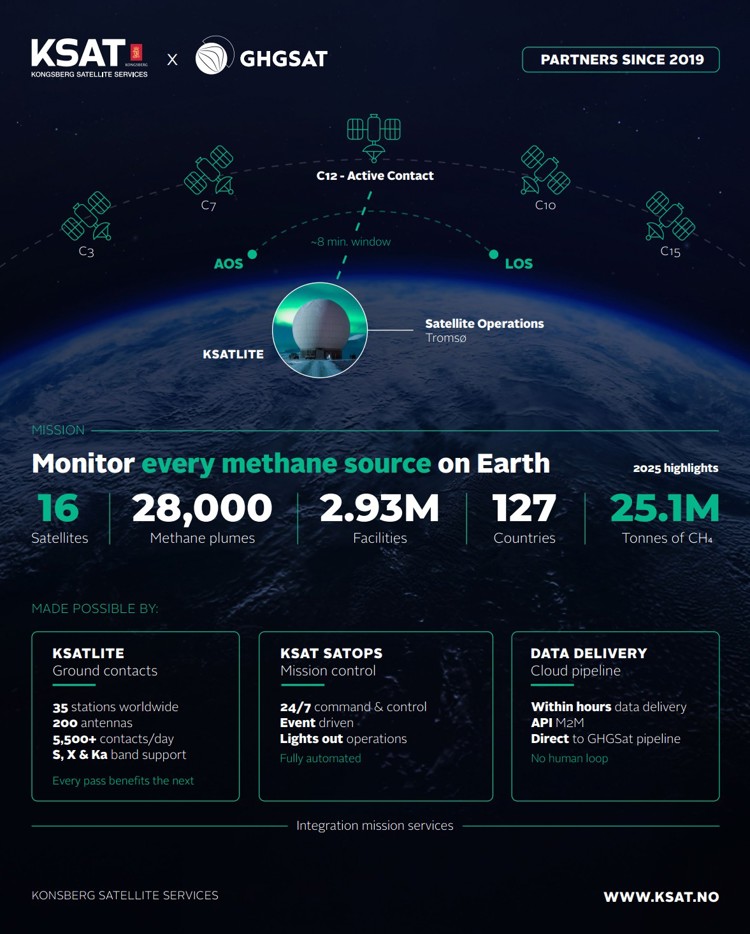
A KSATlite contact delivers data from orbit to the ground. KSAT SatOps takes that further: commanding the satellite, managing its health, scheduling passes, and monitoring the constellation around the clock. When the two are integrated, when the same platform that orchestrates the contact also controls what the satellite does before and after it, something changes fundamentally.
Read the second chapter in our KSATlite series.
The handoffs disappear.
In a traditional architecture, the ground station and the operations center are separate systems operated by separate teams, often at separate companies. When something goes wrong, an anomaly, a missed pass, an unexpected manoeuvre, troubleshooting across fragmented systems means piecing together logs from separate platforms, coordinating between separate teams, and losing critical time. There is no single view of the mission, only partial pictures that have to be reconciled manually by the customer, taking precious time away from delivering a service to their customers.
In an integrated KSATlite and SatOps operation, the contact is not just a data transfer. It is a fully coordinated event: the platform knows what the satellite needs to do next, configures the contact accordingly, monitors health during the pass, routes the data, and prepares the next command uplink, all without a human in the loop.
For a constellation like GHGSat's, 15 satellites as of mid-2026, monitoring almost 3 million industrial facilities across 127 countries, with plans to continue scaling its constellation to meet customer demand, that seamlessness is not a convenience. It is an effective way to scale cost efficiently while ensuring quality in both this mission-critical activity and in the downstream data processed for customers.
Focus on what matters
GHGSat has trusted KSAT to deliver highly reliable ground station contacts and responsive satellite operations to its constellation of microsatellites. The partnership began in 2019 with Earth Observation data services and expanded to the global ground network in 2021. Building on that collaboration, GHGSat entrusted KSAT with the operation of their fleet in 2023.
What KSAT provides, GHGSat does not have to build, staff, or maintain. What GHGSat gains is the freedom to focus entirely on its core mission: delivering actionable emissions intelligence to the industries, governments and regulators trying to close the gap between what gets emitted and what gets measured.
"The partnership enables us to stay focused on our mission and expertise, which is to deliver valuable, actionable emissions data and intelligence to customers worldwide," Germain said when the SatOps agreement was announced.
That sentence contains the logic of the whole model. Ground operations are not GHGSat's product. Earth observation intelligence is. Every hour spent on ground or SatOps operation is an hour not spent on improving detection algorithms, expanding coverage, reducing data latency, or serving customers. Integration removes that trade-off.
Read the third chapter in our KSATlite series.
What changes for the industry
The GHGSat partnership was the first of its kind for something the industry has been circling for years: the externally managed space mission: from ground network and satellite operations to data delivery and cloud integration.
Until recently, the ground segment was treated as infrastructure, a necessary cost that operators manage themselves or contracted piecemeal. Ground stations here. Operations center there. Scheduling tools somewhere else. The result was complexity that scaled badly: each new satellite multiplied the burden on the operations team, rather than being absorbed by the platform.
What KSAT's Integrated Mission Services model demonstrates is that this does not have to be the case. As part of its growth strategy, KSAT has expanded from delivering Ground Station Network services to providing Satellite Operations, as well as other elements of the value chain such as cloud-based services, a response to latent demand from satellite owners to fully externalize the mission management of their fleets.
The implication for the industry is significant. As constellations grow and the cost of building custom ground infrastructure becomes harder to justify, the integrated service model will shift from an option to an expectation. Operators will ask not "who provides my ground stations" but "who can manage my satellite mission infrastructure end-to-end."
KSATlite contacts are where the data moves. SatOps is where the mission lives. Together, they are the infrastructure that lets a company like GHGSat focus on what it was built to do.
The next ten years
GHGSat is continuing its swift expansion and KSAT will scale with it. That scalability is the point. The same platform that manages one satellite manages fifty. The same contact that worked for spacecraft 1 works for spacecraft 50. The operational complexity does not grow linearly with the constellation.
For the operators who are building the next generation of Earth observation, climate monitoring, or communications constellations, that compounding efficiency is the most important thing KSATlite and SatOps offer together: a ground segment that gets better as it gets bigger, and that never asks the mission owner to manage ground infrastructure, satellite health, or data delivery again, because Integrated Mission Services absorbs all of it, so the mission owner can focus entirely on what they were built to do.